In the latest issue of a well known equine publication, an article on thyroid dysfunction suggests that "...most equine diets of hay and pasture grass (other than in the Pacific Northwest) contain far more than the daily required level of iodine...", and, in a sidebar, cautions that supplementation of iodine could worsen a suspected thyroid issue. Also overlooked here is the small but important role selenium plays in thyroid function.
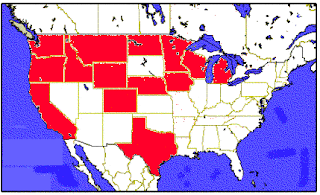 |
| Iodine deficient soils in the United States |
Let's look at some of the facts about iodine.
The National Research Council (NRC), based on the best evidence availablle, suggests a dietary requirement of iodine for horses as a range and recommends using the average of that range as a minimum target.
Suggested range 0.1-0.6 mg Iodine per kilogram of drymatter (DM)
Average of range (0.1-0.6 mg I/kg DM) 0.35 mg I/kg DM
This can also be expressed as a weight-based requirement, presuming the horse has a daily feed intake at 2% of its body weight (BW), which works out similar to the above average.
Maintenance requirement 0.007 mg/kg BW
For a 1000 lb horse, 455 kg x 0.007 = 3.18 mg Iodine/day
For a 1000 lb (455 kg) horse taking in 2% of BW (9.1 kg DM) using the "range" above
low 0.10 * 9.1 = 0.91 mg Iodine (NRC questions if this concentration is sufficient)
avg 0.35 * 9.1 = 3.185 mg Iodine
high 0.60 * 9.1 = 5.46 mg Iodine
(Pregnant or lactaing broodmares have a higher recommended requirement of 0.4 mg I/kg DM.)
The maximum tolerable level for iodine has been set at 5 mg I/kg DM, or
45.5 mg for a 1,000 lb (455 kg) horse. In a few instances (AZ horses on CAP water, high nitrates in hay, which I now always check in Southwestern hays and other grass hays with high protein levels) I will double the NRC recommendation but otherwise stick with the mid to high range.
From NRC - "Iodine toxicity [seen as goiter] usually results
only when iodine is oversupplemented or when animals are receiving feeds containing unusually high amounts of iodine such as some types of seaweed." but toxicity in mares receiving as little as 40 mg a day has been reported.
Iodine concentrations in most common feedstuffs range from 0 to 2 mg/kg DM (equivalent to 0 to 18 mg in 20 lbs or 9.1 kg of hay) depending on the iodine concentration in the soil in which they are grown. As with other minerals, many conditions can affect forage uptake of iodine from the soil and different farming practices may deplete or concentrate available levels.
Depending on free-choice intake of iodized salt to supply iodine requirements has been shown to result in iodine deficiency in pregnant mares resulting in leg abnormalities in foals, and even when iodized salt is directly added to the feed, the amount may not meed NRC requirements.
Without going overboard, ensuring an Iodine intake level equal to the standard NRC recommendation of 0.35 ppm up to the "high" range of 0.6 ppm might also provide insurance against uptake of the [very] low levels of I-131 detected by Environmental Protection Agency (EPA) monitoring and other environmental "insults".
It is unlikely that using even the higher suggested range would tip your horse over the maximum tolerable level even if your forage contains a fairly high level of iodine. But we should also keep in mind that there is little direct equine research on iodine; without this it's difficult to consider levels higher than those which have been documented to cause goiter in studied horses - 5 mg I/kg DM, or 45.5 mg for a 1,000 lb (455 kg) horse.

Iodine testing for hay and forage is not readily available at most forage labs in the US; when it is the cost may be prohibitive. For example, at
Cumberland Valley Analytical Lab, the price for their Iodine test is $75. On the other hand, if your horse is experiencing issues you feel may be related to excessive iodine intake, the cost may be a worthwhile investment.
Iodine serum level testing (Iodine Total and Iodine Inorganic) is offered at the Michigan State Diagnostic Center. From their
Iodine Testing document :
Total serum iodine and particularly serum inorganic iodine reflect the current dietary iodine consumption. Serum inorganic iodine is a good short-term measure of iodine consumption and will reflect excessive iodine supplementation, when present.
Often overlooked when considering possible thyroid dysfunction is
selenium deficiency - selenium is necessary for conversion of the inactive hormone T4 to the active thyroid hormone T3 and selenium deficiency together with high iodine intake may result in low T4 levels and other thyroid issues.
http://www.ncbi.nlm.nih.gov/pubmed/9187638 Selenium level testing in whole blood in horses is readily available and also easily included in forage testing (generally under $40).
In summary, iodine is but one element of an overall mineral balanced equine diet. As with any other mineral or supplement, targeting just one nutrient without taking into account how all nutrients interact with one another is not likely to produce the desired results.
Don't throw away the iodized salt or iodine supplement but do make sure that protein, calories, major minerals and other trace minerals are balanced and appropriate for the horse's age, weight, work and reproductive status. Check that any kelp or seaweed products you use contain guaranteed levels of iodine. "Sea salt", despite the reassuring name, often contains only minute traces of iodine and can't be relied on as an iodine source.
The next time your vet draws blood consider having her check a selenium level - especially if it's been suggested to add a "thyroid" supplement. It makes little sense to use a drug to correct a basic trace mineral deficiency - adding the NRC recommended levels of iodine and selenium may help normalize thyroid function test results.
Warm regards,
Patti in monsoon flooded Vail Az
Don't forget the salt!
Links
Nutrient Requirements of Horses, Sixth Revised Edition (NRC 2007) Pages 91-92.
http://www.nap.edu/catalog.php?record_id=11653
My previous post about iodine - not much has changed
http://desertequinebalance.blogspot.com/2006/10/iodine-requirement-in-equine-rations.html
and thyroid (including links to Dr. Eleanor Kellon's "Understanding Thyroid" article in Holistic Horse)
http://desertequinebalance.blogspot.com/2013/02/understanding-thyroid.html
Cumberland Valley Analytical Services
http://www.foragelab.com/Lab-Services/Forage-and-Feed/Price-List
Iodine Deficient Soils Map
http://www.goatworld.com/articles/nutrition/iodine.shtml
Michigan State Diagnostic Center for Population and Animal Health
http://www.animalhealth.msu.edu/Bin/Catalog.exe?Action=Test&PAGE=12&Id=2236
http://www.animalhealth.msu.edu/Bin/Catalog.exe?Action=Test&PAGE=12&Id=2920
http://www.animalhealth.msu.edu/Sections/Nutrition/WEBCD.Nutr.REF.003.pdf


